EX-99.2
Published on May 7, 2026
Cerence Q2 May 7, 2026 Brian Krzanich, Chief Executive Officer Tony Rodriquez, Chief Financial Officer

Forward-Looking Statements Statements in this presentation as well as oral statements made by Cerence management from time to time, regarding: Cerence’s future performance, results and financial condition; expected growth, profitability and cash flow; outlook and momentum; Cerence's business model; transformation plans and cost efficiency initiatives; strategy; opportunities; business, industry and market trends; plans and expectations regarding fixed license contracts and the impact on financial results; revenue visibility; backlog; revenue timing and mix; demand for Cerence products; innovation and new product offerings, including AI technology and Cerence xUI; expected benefits of technology partnerships; IP licensing, enforcement, and protection efforts; and management’s future expectations, anticipations, intentions, estimates, assumptions, beliefs, goals, objectives, targets, plans, outlook or prospects constitute forward-looking statements within the meaning of the Private Securities Litigation Reform Act of 1995. Any statements that are not statements of historical fact (including statements containing the words “believes,” “plans,” “goal,” “objective,” “anticipates,” “projects,” “forecasts,” “expects,” “intends,” “continues,” “will,” “may,” or “estimates” or similar expressions) should also be considered to be forward-looking statements. Although we believe forward-looking statements are based upon reasonable assumptions as of the date of this press release, such statements involve known and unknown risk, uncertainties and other factors, which may cause actual results or performance of the company to be materially different from any future results or performance expressed or implied by such forward-looking statements including but not limited to: the highly competitive and rapidly changing market in which we operate; adverse conditions in the automotive industry or the global economy more generally; volatility in the political, legal and regulatory environment in which we operate, including trade, tariffs and other policies implemented by the United States, actions taken by other countries in response or other changes in law and regulation applicable to us; the ongoing conflicts in Ukraine and the Middle East; risks of international operations, including in China; automotive production curtailment or delays; changes in customer forecasts and the timing and receipt of royalty reports; our inability to control and successfully manage our expenses and cash position; our inability to deliver improved financial results from process optimization efforts and cost reduction actions; pricing pressures from our customers; the impact on our business of the transition to a lower level of fixed license contracts, including the failure to achieve such a transition; our failure to win, renew or implement service contracts; the cancellation or postponement of existing contracts; the loss of business from any of our largest customers; effects of customer defaults; a decrease in the level of professional services projects; fluctuations in our financial and operating results, including as a result of licensing transactions and litigation settlements or judgments; our inability to successfully introduce and drive customer adoption of new products, applications and services; our strategies to increase cloud offerings and deploy generative AI and large language models (LLMs) and shift to more recurring revenue streams; the inability to expand into adjacent or non-auto markets; the inability to recruit and retain qualified personnel; cybersecurity and data privacy incidents and compliance with global privacy and data security requirements; failure to protect our intellectual property; adverse developments related to our intellectual property enforcement litigation, the outcome of such litigation, or remedies that could be awarded in connection with such litigation; risks and challenges posed by the development and use of artificial intelligence; the evolving regulatory landscape governing artificial intelligence; defects or interruptions in service with respect to our products; supply chain interruptions; fluctuating currency rates and interest rates; inflation; financial and credit market volatility; restrictions on our current and future operations under the terms of our debt; the use of cash to service or repay our debt; and our inability to generate sufficient cash from our operations; and the other factors discussed in our most recent Annual Report on Form 10-K, quarterly reports on Form 10-Q, and other filings with the Securities and Exchange Commission. We disclaim any obligation to update any forward-looking statements as a result of developments occurring after the date of this document. 2

3 Q2 FY26
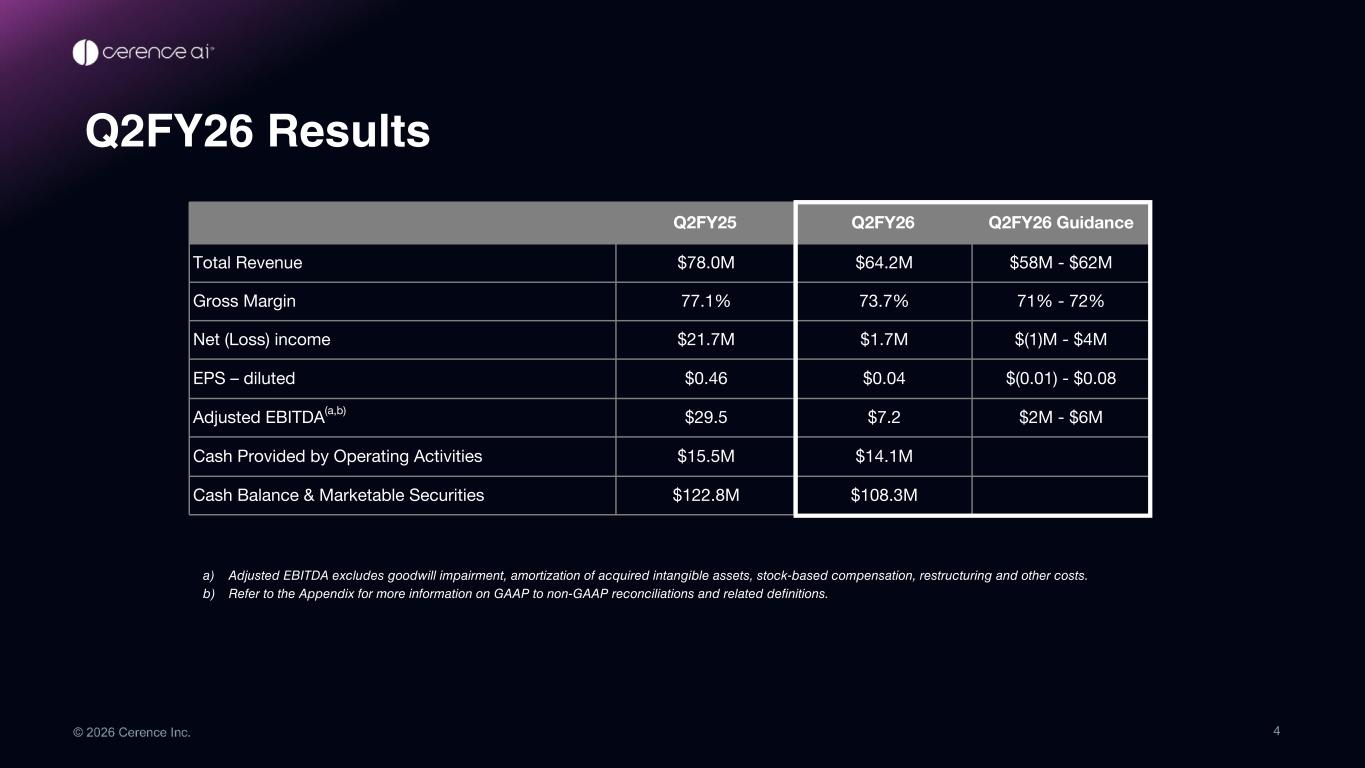
Q2FY26 Results 4 Q2FY25 Q2FY26 Q2FY26 Guidance Total Revenue $78.0M $64.2M $58M - $62M Gross Margin 77.1% 73.7% 71% - 72% Net (Loss) income $21.7M $1.7M $(1)M - $4M EPS – diluted $0.46 $0.04 $(0.01) - $0.08 Adjusted EBITDA(a,b) $29.5 $7.2 $2M - $6M Cash Provided by Operating Activities $15.5M $14.1M Cash Balance & Marketable Securities $122.8M $108.3M a) Adjusted EBITDA excludes goodwill impairment, amortization of acquired intangible assets, stock-based compensation, restructuring and other costs. b) Refer to the Appendix for more information on GAAP to non-GAAP reconciliations and related definitions.
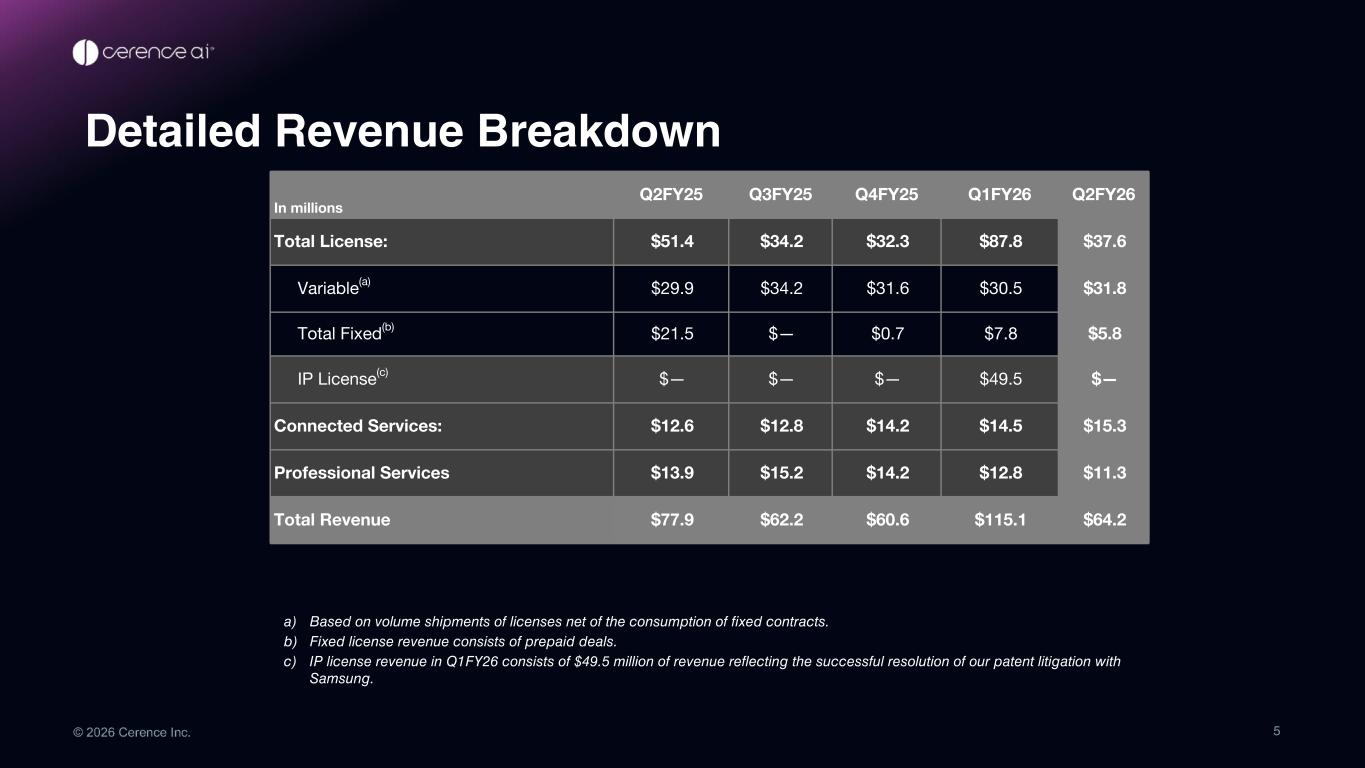
In millions Q2FY25 Q3FY25 Q4FY25 Q1FY26 Q2FY26 Total License: $51.4 $34.2 $32.3 $87.8 $37.6 Variable(a) $29.9 $34.2 $31.6 $30.5 $31.8 Total Fixed(b) $21.5 $— $0.7 $7.8 $5.8 IP License(c) $— $— $— $49.5 $— Connected Services: $12.6 $12.8 $14.2 $14.5 $15.3 Professional Services $13.9 $15.2 $14.2 $12.8 $11.3 Total Revenue $77.9 $62.2 $60.6 $115.1 $64.2 a) Based on volume shipments of licenses net of the consumption of fixed contracts. b) Fixed license revenue consists of prepaid deals. c) IP license revenue in Q1FY26 consists of $49.5 million of revenue reflecting the successful resolution of our patent litigation with Samsung. Detailed Revenue Breakdown 5
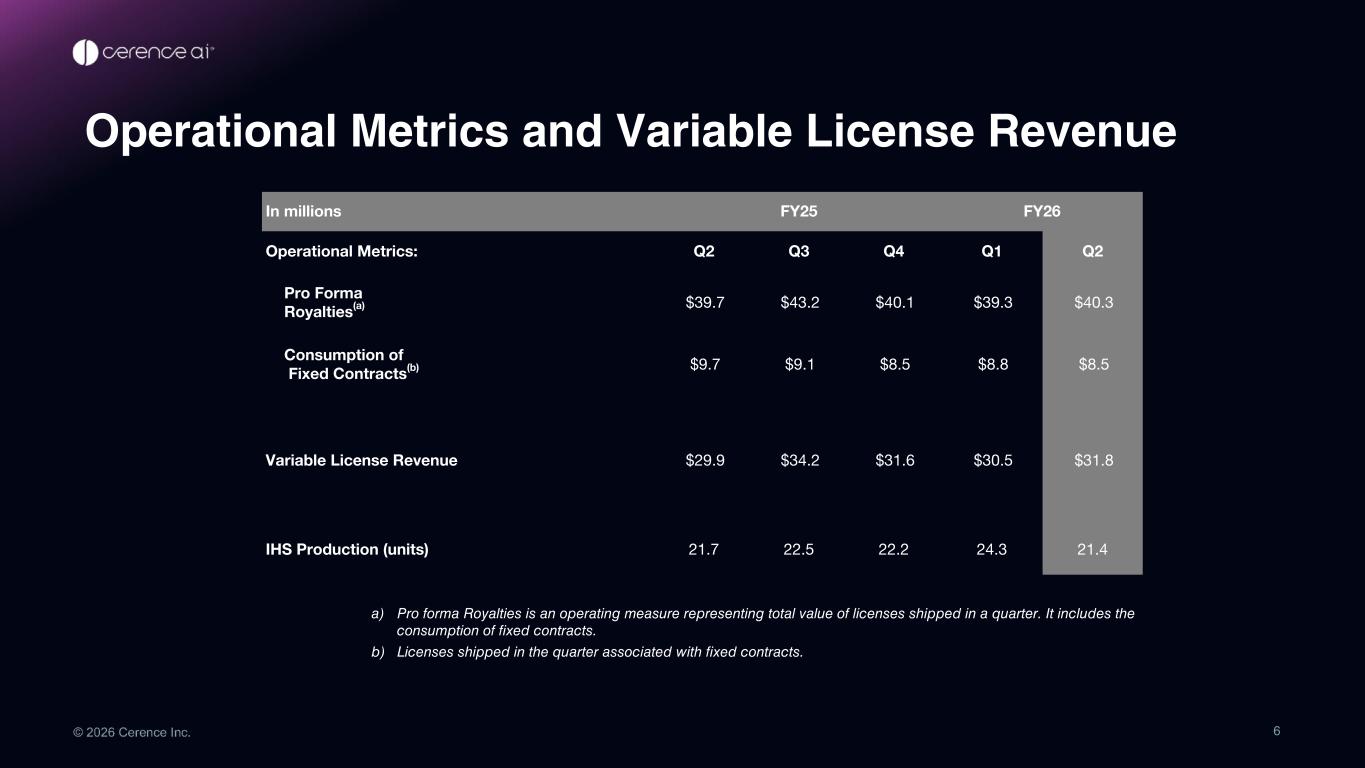
In millions FY25 FY26 Operational Metrics: Q2 Q3 Q4 Q1 Q2 Pro Forma Royalties(a) $39.7 $43.2 $40.1 $39.3 $40.3 Consumption of Fixed Contracts(b) $9.7 $9.1 $8.5 $8.8 $8.5 Variable License Revenue $29.9 $34.2 $31.6 $30.5 $31.8 IHS Production (units) 21.7 22.5 22.2 24.3 21.4 a) Pro forma Royalties is an operating measure representing total value of licenses shipped in a quarter. It includes the consumption of fixed contracts. b) Licenses shipped in the quarter associated with fixed contracts. Operational Metrics and Variable License Revenue 6
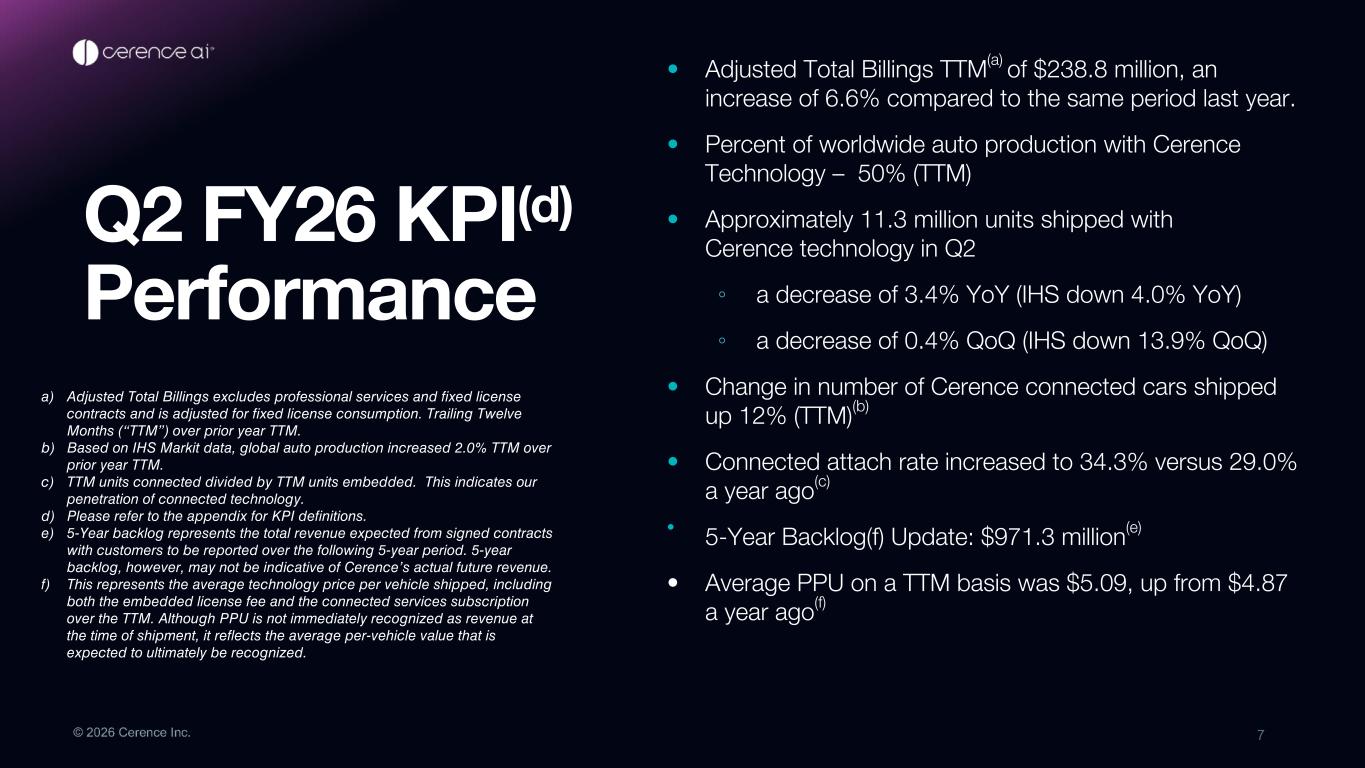
• Adjusted Total Billings TTM(a) of $238.8 million, an increase of 6.6% compared to the same period last year. • Percent of worldwide auto production with Cerence Technology – 50% (TTM) • Approximately 11.3 million units shipped with Cerence technology in Q2 ◦ a decrease of 3.4% YoY (IHS down 4.0% YoY) ◦ a decrease of 0.4% QoQ (IHS down 13.9% QoQ) • Change in number of Cerence connected cars shipped up 12% (TTM)(b) • Connected attach rate increased to 34.3% versus 29.0% a year ago(c) • 5-Year Backlog(f) Update: $971.3 million(e) • Average PPU on a TTM basis was $5.09, up from $4.87 a year ago(f) Q2 FY26 KPI(d) Performance 7 a) Adjusted Total Billings excludes professional services and fixed license contracts and is adjusted for fixed license consumption. Trailing Twelve Months (“TTM”) over prior year TTM. b) Based on IHS Markit data, global auto production increased 2.0% TTM over prior year TTM. c) TTM units connected divided by TTM units embedded. This indicates our penetration of connected technology. d) Please refer to the appendix for KPI definitions. e) 5-Year backlog represents the total revenue expected from signed contracts with customers to be reported over the following 5-year period. 5-year backlog, however, may not be indicative of Cerence’s actual future revenue. f) This represents the average technology price per vehicle shipped, including both the embedded license fee and the connected services subscription over the TTM. Although PPU is not immediately recognized as revenue at the time of shipment, it reflects the average per-vehicle value that is expected to ultimately be recognized.
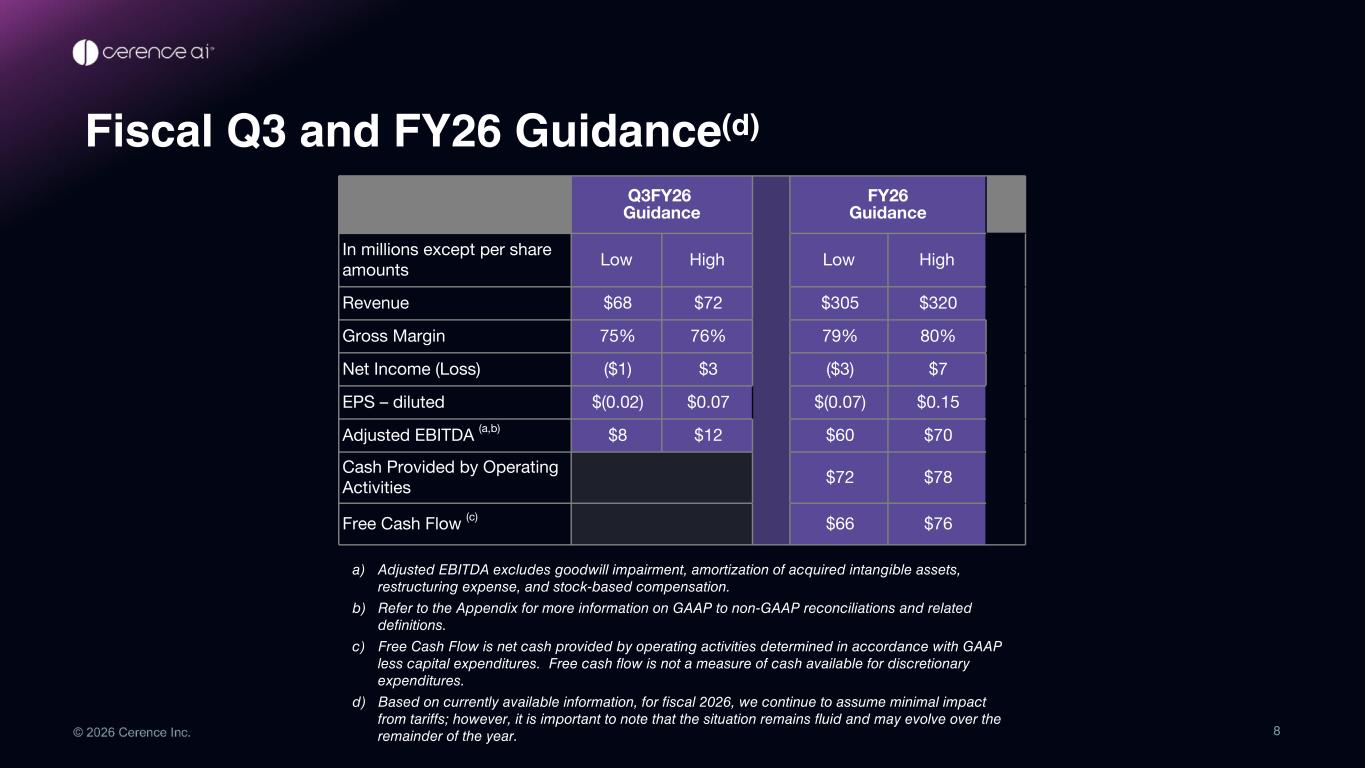
Fiscal Q3 and FY26 Guidance(d) 8 Q3FY26 Guidance FY26 Guidance In millions except per share amounts Low High Low High Revenue $68 $72 $305 $320 Gross Margin 75% 76% 79% 80% Net Income (Loss) ($1) $3 ($3) $7 EPS – diluted $(0.02) $0.07 $(0.07) $0.15 Adjusted EBITDA (a,b) $8 $12 $60 $70 Cash Provided by Operating Activities $72 $78 Free Cash Flow (c) $66 $76 a) Adjusted EBITDA excludes goodwill impairment, amortization of acquired intangible assets, restructuring expense, and stock-based compensation. b) Refer to the Appendix for more information on GAAP to non-GAAP reconciliations and related definitions. c) Free Cash Flow is net cash provided by operating activities determined in accordance with GAAP less capital expenditures. Free cash flow is not a measure of cash available for discretionary expenditures. d) Based on currently available information, for fiscal 2026, we continue to assume minimal impact from tariffs; however, it is important to note that the situation remains fluid and may evolve over the remainder of the year.

9 Appendix
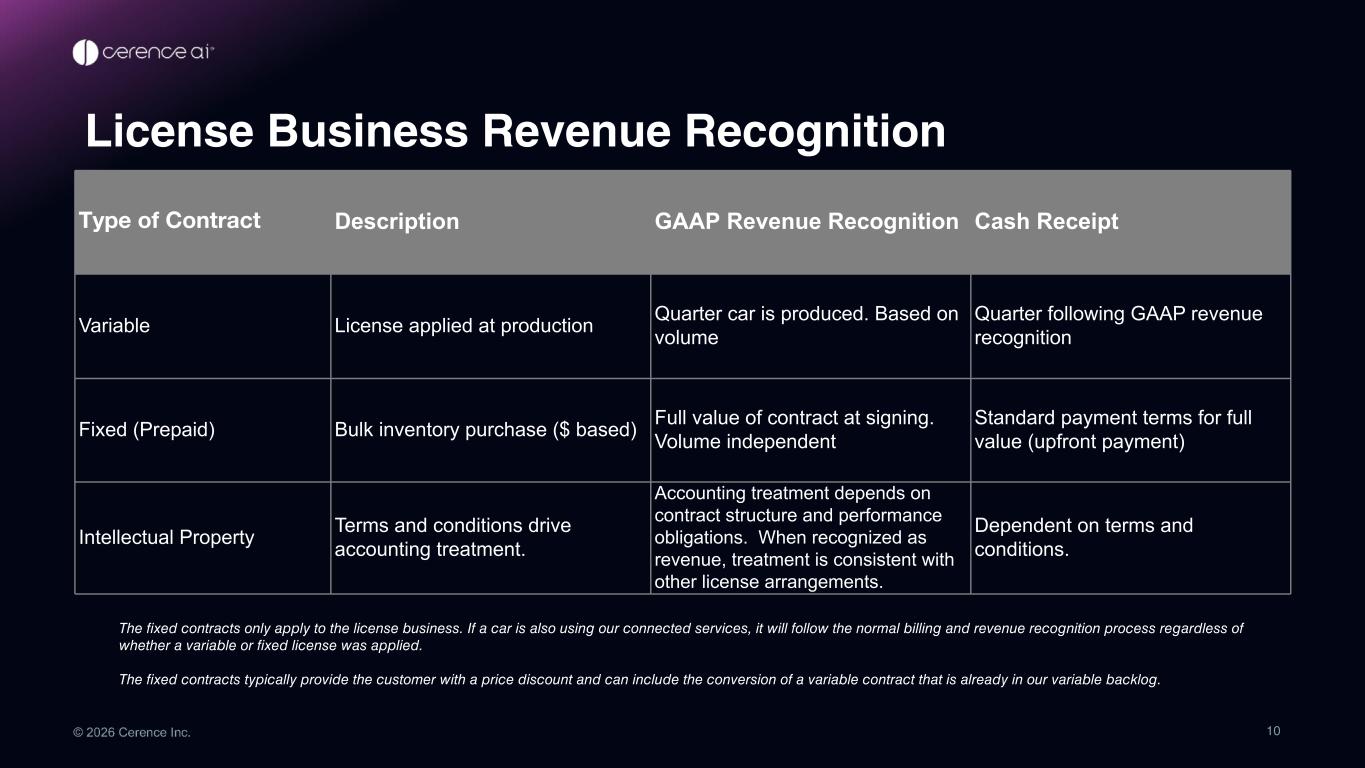
License Business Revenue Recognition Type of Contract Description GAAP Revenue Recognition Cash Receipt Variable License applied at production Quarter car is produced. Based on volume Quarter following GAAP revenue recognition Fixed (Prepaid) Bulk inventory purchase ($ based) Full value of contract at signing. Volume independent Standard payment terms for full value (upfront payment) Intellectual Property Terms and conditions drive accounting treatment. Accounting treatment depends on contract structure and performance obligations. When recognized as revenue, treatment is consistent with other license arrangements. Dependent on terms and conditions. 10 The fixed contracts only apply to the license business. If a car is also using our connected services, it will follow the normal billing and revenue recognition process regardless of whether a variable or fixed license was applied. The fixed contracts typically provide the customer with a price discount and can include the conversion of a variable contract that is already in our variable backlog.
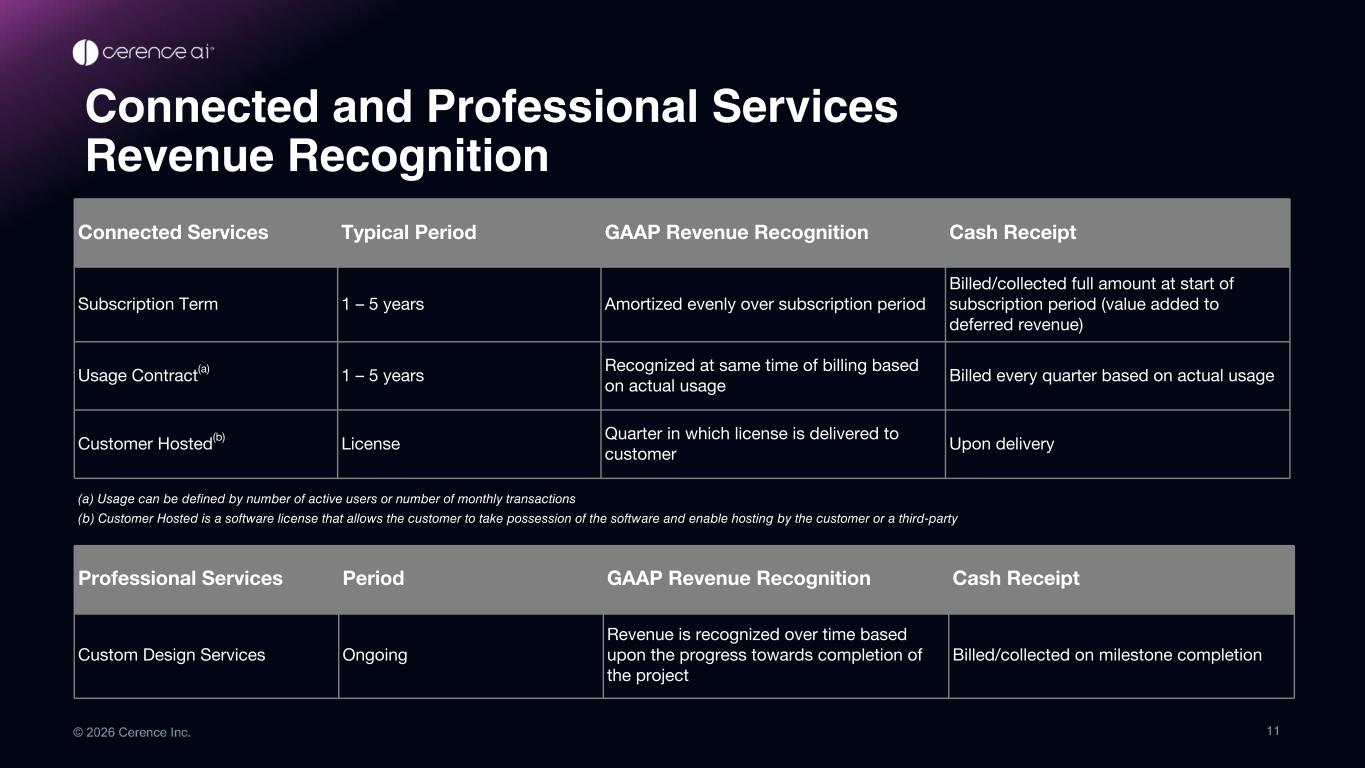
Connected and Professional Services Revenue Recognition Connected Services Typical Period GAAP Revenue Recognition Cash Receipt Subscription Term 1 – 5 years Amortized evenly over subscription period Billed/collected full amount at start of subscription period (value added to deferred revenue) Usage Contract(a) 1 – 5 years Recognized at same time of billing based on actual usage Billed every quarter based on actual usage Customer Hosted(b) License Quarter in which license is delivered to customer Upon delivery 11 (a) Usage can be defined by number of active users or number of monthly transactions (b) Customer Hosted is a software license that allows the customer to take possession of the software and enable hosting by the customer or a third-party Professional Services Period GAAP Revenue Recognition Cash Receipt Custom Design Services Ongoing Revenue is recognized over time based upon the progress towards completion of the project Billed/collected on milestone completion
KPI Measures – Definitions We believe that providing key performance indicators (“KPIs”) allows investors to gain insight into the way management views the performance of the business as well as a potentially new KPI, Average PPU. We further believe that providing KPIs allows investors to better understand information used by management to evaluate and measure such performance. KPIs should not be considered superior to, or a substitute for, operating results prepared in accordance with GAAP. In assessing the performance of the business during the three and six months ended March 31, 2026, our management has reviewed the following KPIs, each of which is described below: • Percent of worldwide auto production with Cerence Technology (TTM): The number of Cerence enabled cars shipped on a TTM basis as compared to IHS Markit car production data. • Change in number of Cerence connected cars shipped: The year-over-year change in the number of cars shipped with Cerence connected solutions. Amounts calculated on a TTM basis. • Change in Adjusted total billings YoY (TTM): The year over year change in total billings excluding Professional Services and fixed license billings and adjusted for fixed license consumption. Amounts calculated on a TTM over prior year TTM basis. • Connected Attached Rate: the percentage of vehicles shipped with connected technology, calculated as TTM units connected divided by TTM units embedded. • Average PPU: This represents the average technology price per vehicle shipped, including both the embedded license fee and the connected services subscription. Although PPU is not immediately recognized as revenue at the time of shipment, it reflects the average per-vehicle value that is expected to ultimately be recognized. 12
Non-GAAP Financial Measures – Definitions Discussion of Non-GAAP Financial Measures We believe that providing the non-GAAP information, in addition to the GAAP presentation, allows investors to view the financial results in the way management views the operating results. We further believe that providing this information allows investors to not only better understand our financial performance, but more importantly, to evaluate the efficacy of the methodology and information used by management to evaluate and measure such performance. The non-GAAP information should not be considered superior to, or a substitute for, financial statements prepared in accordance with GAAP. We utilize a number of different financial measures, both GAAP and non-GAAP, in analyzing and assessing the overall performance of the business, for making operating decisions and for forecasting and planning for future periods. While our management uses these non-GAAP financial measures as a tool to enhance their understanding of certain aspects of our financial performance, our management does not consider these measures to be a substitute for, or superior to, the information provided by GAAP financial statements. Consistent with this approach, we believe that disclosing non-GAAP financial measures to the readers of our financial statements provides such readers with useful supplemental data that, while not a substitute for GAAP financial statements, allows for greater transparency in the review of our financial and operational performance. In assessing the overall health of the business during the three and six months ended March 31, 2026 and 2025, our management has either included or excluded the following items in general categories, each of which is described below. 13
Non-GAAP Financial Measures – Definitions Adjusted EBITDA. Adjusted EBITDA is defined as net income attributable to Cerence Inc. before net income (loss) attributable to income tax (benefit) expense, other income (expense) items, net, depreciation and amortization expense, and excluding amortization of acquired intangible assets, stock-based compensation, and restructuring and other costs, net and impairment charges related to fixed and intangible assets and gains or losses on the sale of long-lived assets, if any. From time to time we may exclude from Adjusted EBITDA the impact of events, gains, losses or other charges that affect the period-to-period comparability of our operating performance. Other income (expense) items, net include interest expense, interest income, and other income (expense), net (as stated in our Condensed Consolidated Statement of Operations). Our management and Board of Directors use this financial measure to evaluate our operating performance. It is also a significant performance measure in our annual incentive compensation programs. Restructuring and other costs, net. Restructuring and other costs, net include restructuring expenses as well as other charges that are unusual in nature, are the result of unplanned events, and arise outside the ordinary course of our business such as employee severance costs, consulting costs relating to our transformation initiatives, and costs for consolidating duplicate facilities. Amortization of acquired intangible assets. We exclude the amortization of acquired intangible assets from non-GAAP expense and income measures. These amounts are inconsistent in amount and frequency and are significantly impacted by the timing and size of acquisitions. Providing a supplemental measure which excludes these charges allows management and investors to evaluate results “as-if” the acquired intangible assets had been developed internally rather than acquired and, therefore, provides a supplemental measure of performance in which our acquired intellectual property is treated in a comparable manner to our internally developed intellectual property. Although we exclude amortization of acquired intangible assets from our non-GAAP expenses, we believe that it is important for investors to understand that such intangible assets contribute to revenue generation. Amortization of intangible assets that relate to past acquisitions will recur in future periods until such intangible assets have been fully amortized. Future acquisitions may result in the amortization of additional intangible assets. 14
Non-GAAP Financial Measures – Definitions Stock-based compensation. Because of varying valuation methodologies, subjective assumptions and the variety of award types, we exclude stock-based compensation from our operating results. We evaluate performance both with and without these measures because compensation expense related to stock-based compensation is typically non-cash and awards granted are influenced by the Company’s stock price and other factors such as volatility that are beyond our control. The expense related to stock-based awards is generally not controllable in the short-term and can vary significantly based on the timing, size and nature of awards granted. As such, we do not include such charges in operating plans. Stock-based compensation will continue in future periods. Other expenses. We exclude certain other expenses that result from unplanned events outside the ordinary course of continuing operations, in order to measure operating performance and current and future liquidity both with and without these expenses. By providing this information, we believe management and the users of the financial statements are better able to understand the financial results of what we consider to be our organic, continuing operations. Included in these expenses are items such as other charges (credits), net (gains) losses from extinguishment of debt, net (gains) losses from foreign currency translation, and changes in indemnification assets corresponding with the release of pre-spin liabilities for uncertain tax positions. Non-GAAP total operating expenses. Non-GAAP total operating expenses reflect GAAP operating expenses excluding stock-based compensation, intangible asset amortization, and restructuring and other costs. Our management and Board of Directors use this financial measure to evaluate our operating performance. It is also a significant performance measure in our annual incentive compensation programs. 15
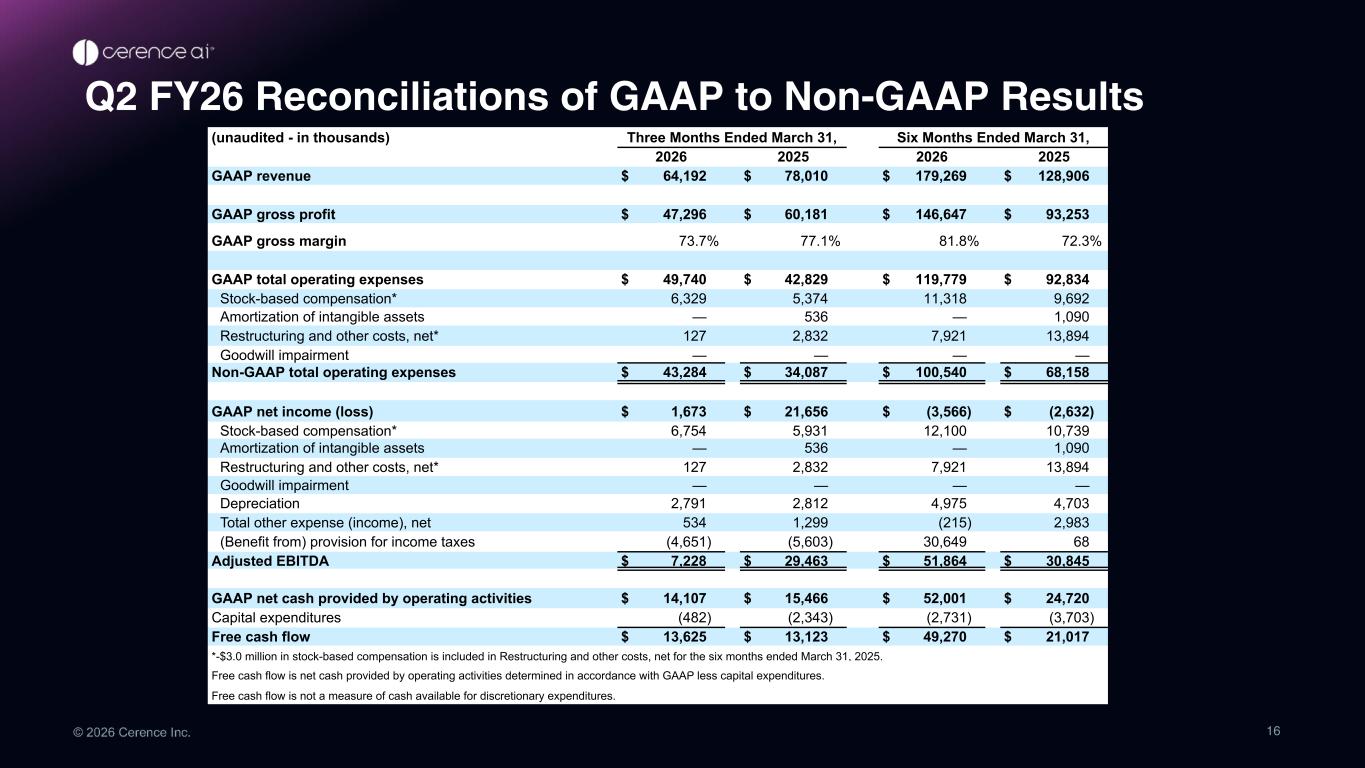
Q2 FY26 Reconciliations of GAAP to Non-GAAP Results 16 Free cash flow is net cash provided by operating activities determined in accordance with GAAP less capital expenditures. Free cash flow is not a measure of cash available for discretionary expenditures. (unaudited - in thousands) (unaudited - in thousands) Three Months Ended March 31, Six Months Ended March 31, 2026 2025 2026 2025 GAAP revenue $ 64,192 $ 78,010 $ 179,269 $ 128,906 GAAP gross profit $ 47,296 $ 60,181 $ 146,647 $ 93,253 GAAP gross margin 73.7% 77.1% 81.8% 72.3% GAAP total operating expenses $ 49,740 $ 42,829 $ 119,779 $ 92,834 Stock-based compensation* 6,329 5,374 11,318 9,692 Amortization of intangible assets — 536 — 1,090 Restructuring and other costs, net* 127 2,832 7,921 13,894 Goodwill impairment — — — — Non-GAAP total operating expenses $ 43,284 $ 34,087 $ 100,540 $ 68,158 GAAP net income (loss) $ 1,673 $ 21,656 $ (3,566) $ (2,632) Stock-based compensation* 6,754 5,931 12,100 10,739 Amortization of intangible assets — 536 — 1,090 Restructuring and other costs, net* 127 2,832 7,921 13,894 Goodwill impairment — — — — Depreciation 2,791 2,812 4,975 4,703 Total other expense (income), net 534 1,299 (215) 2,983 (Benefit from) provision for income taxes (4,651) (5,603) 30,649 68 Adjusted EBITDA $ 7,228 $ 29,463 $ 51,864 $ 30,845 GAAP net cash provided by operating activities $ 14,107 $ 15,466 $ 52,001 $ 24,720 Capital expenditures (482) (2,343) (2,731) (3,703) Free cash flow $ 13,625 $ 13,123 $ 49,270 $ 21,017 *-$3.0 million in stock-based compensation is included in Restructuring and other costs, net for the six months ended March 31, 2025. Free cash flow is net cash provided by operating activities determined in accordance with GAAP less capital expenditures. Free cash flow is not a measure of cash available for discretionary expenditures. * - $3.0 million in stock-based compensation is included in Restructuring and other costs, net for Q1'25.
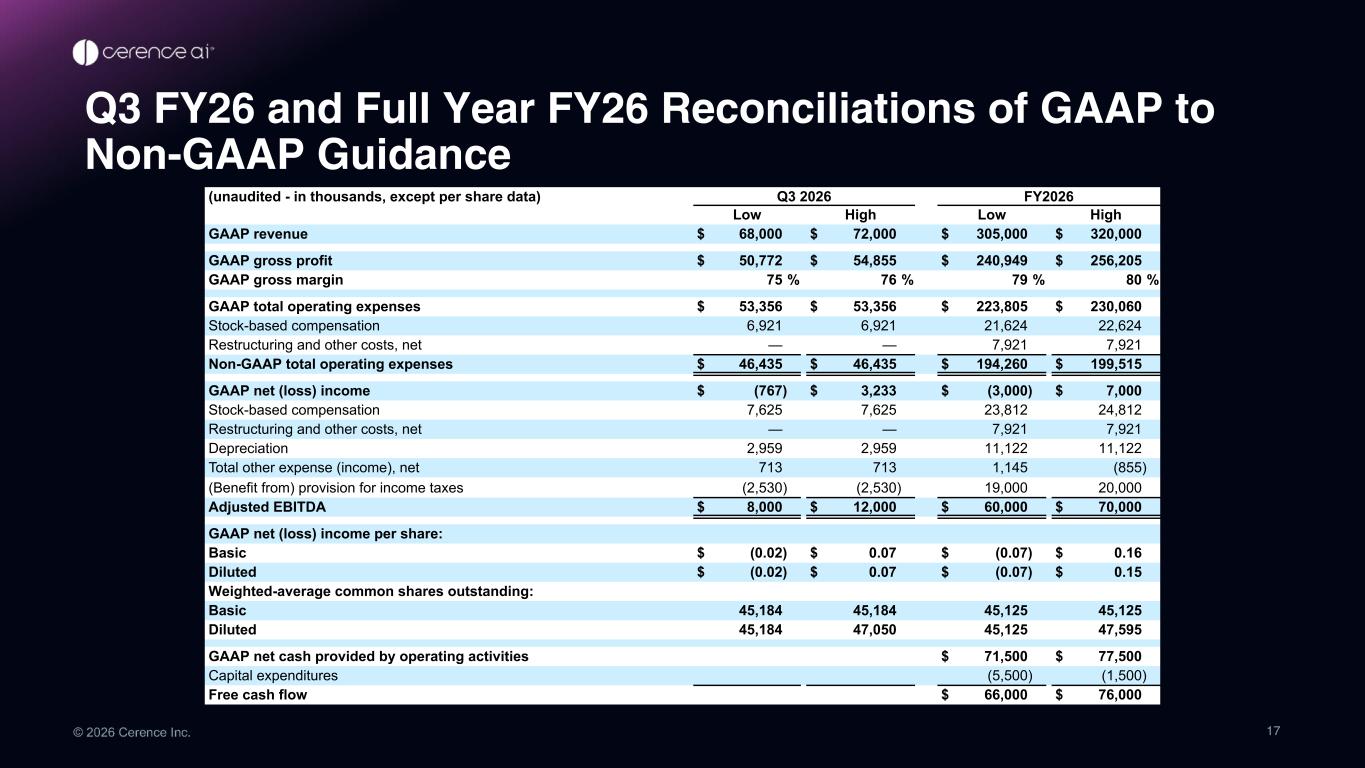
Q3 FY26 and Full Year FY26 Reconciliations of GAAP to Non-GAAP Guidance 17 (unaudited - in thousands, except per share data) Q3 2026 FY2026 Low High Low High GAAP revenue $ 68,000 $ 72,000 $ 305,000 $ 320,000 GAAP gross profit $ 50,772 $ 54,855 $ 240,949 $ 256,205 GAAP gross margin 75 % 76 % 79 % 80 % GAAP total operating expenses $ 53,356 $ 53,356 $ 223,805 $ 230,060 Stock-based compensation 6,921 6,921 21,624 22,624 Restructuring and other costs, net — — 7,921 7,921 Non-GAAP total operating expenses $ 46,435 $ 46,435 $ 194,260 $ 199,515 GAAP net (loss) income $ (767) $ 3,233 $ (3,000) $ 7,000 Stock-based compensation 7,625 7,625 23,812 24,812 Restructuring and other costs, net — — 7,921 7,921 Depreciation 2,959 2,959 11,122 11,122 Total other expense (income), net 713 713 1,145 (855) (Benefit from) provision for income taxes (2,530) (2,530) 19,000 20,000 Adjusted EBITDA $ 8,000 $ 12,000 $ 60,000 $ 70,000 GAAP net (loss) income per share: Basic $ (0.02) $ 0.07 $ (0.07) $ 0.16 Diluted $ (0.02) $ 0.07 $ (0.07) $ 0.15 Weighted-average common shares outstanding: Basic 45,184 45,184 45,125 45,125 Diluted 45,184 47,050 45,125 47,595 GAAP net cash provided by operating activities $ 71,500 $ 77,500 Capital expenditures (5,500) (1,500) Free cash flow $ 66,000 $ 76,000